Director of Teaching and Learning
ISSUE 9 | 2 April 2026
As the term comes to a close, it seems appropriate to reflect not only on what has been learned, but how it has been learned and, importantly, who we have become in the process. This term, our learning has embodied the College value of Generosity of Spirit in ways both quiet and profound.
Learning is often perceived as an individual pursuit, measured in marks, milestones, and outcomes. Yet across our classrooms, it has been something far richer: a shared endeavour shaped by encouragement, collaboration, and care. Students have shown generosity not only in supporting one another through challenges. We have seen this spirit come to life in group projects where ideas were built together rather than competed over; in classrooms where questions were welcomed as invitations rather than uncertainties; and in moments where persistence was strengthened by the reassurance of others. These are the habits of learners who understand that growth is not diminished by sharing it, it is multiplied.
Our teachers, too, have modelled this generosity. Through thoughtful design, responsive teaching, and a deep commitment to knowing their students, they have created environments where each learner feels seen, challenged, and supported. This relational approach to learning reminds us that success is not simply about achievement, but about belonging and becoming.
As we celebrate the accomplishments of the term, academic, creative, and personal, we recognise that they are underpinned by this culture of generosity. It is what allows our students to take intellectual risks, to persevere through complexity, and to grow with confidence and humility.
Looking ahead, we hope to continue nurturing this spirit: to approach learning not as a solitary endeavour, but as a shared journey; to measure success not only by what we achieve, but by how we grow throughout the process.
I congratulate all students on their efforts this term and thank our community for continuing to make our College a place where learning is enriched through care, connection, and shared purpose.
Alison Boyd-Boland
Directory of Teaching and Learning
Director of Teaching and Learning
ISSUE 7 | 13 March 2026
Our Year 7 and 9 students were some of the 1.4. million students who commenced their NAPLAN assessments this week, demonstrating their growing proficiency in literacy and numeracy. This demonstration of growth is the primary purpose of NAPLAN- capturing where students are at and what progress they have achieved since their last assessment.
The National Assessment Program states that the objectives of these assessments are to:
- allow parents/carers and educators to see how students are progressing in literacy and numeracy over time – individually, as part of their school community, and against national standards.
- provide schools, states and territories with information about how education approaches are working, areas to be prioritised for improvement, and those schools requiring support in the teaching and learning of literacy and numeracy.
Unfortunately, every year there continues to be rhetoric that undermines and / or misunderstands these aims. Headlines from a radio station asking ‘Does the word 'NAPLAN' strike fear into the hearts of your kids?’ are not helpful. Equally, statements about systems ‘failing’ or that these assessments don’t matter in the grand scheme of this are also problematic.
Students should feel like they are failing. They aren’t. But they might be learning at a different pace and they might be in need of additional support.
There is certainly more to learning than NAPLAN. It will not assess persistence, creativity, focus, character or values. These assessments are focused on a particular cluster of skills that enable students to access learning across all disciplines and programs.
But NAPLAN does matter. It is a valuable insight into how students are progressing in their literacy and numeracy skills. This insight is helpful for students, families and especially for schools who can use it to design next steps in learning. And these skills do matter in the grand scheme of things as they enable individuals to communicate, interpret, understand so much of what is around them.
We commend our Year 7 and year 9 students for the focus with which they have approached their first assessments. They will continue with these assessments into next week.
Alison Boyd-Boland
Directory of Teaching and Learning
Director of Teaching and Learning
ISSUE 6 | 6 March 2026
At this point in the term there is an inevitable shift of focus to many of the cohort assessment tasks that start to appear in calendars and student diaries. These assessments are purposeful and can:
- Accelerate learning
- Drive focus and persistence
- Offer opportunity to show growth and or mastery
They can appear to superficially be about a score or rank. But the deeper purpose of assessment is to support learning, not measure it.
Assessment is a conversation. Tasks, feedback, and reflection work together to make learning visible. Students gain insight into how they think, solve problems, and the ways their skills develop over time. Teachers use assessment evidence to adjust instruction, clarify expectations, and design learning experiences that respond to students’ needs. In this sense, assessment is not an endpoint but part of the learning process itself.
The College has adopted this definition of assessment:
Assessment is a natural part of learning as at its core it is designed to “establish and understand where learners are in an aspect of their learning at the time of assessment” (Masters 2014) so that the next steps in learning can be designed appropriately.
Assessment therefore happens all the time. Through questions, collaborative tasks, dialogue, independent activities, formal assessment tasks, group projects, students are constantly demonstrating what they know and can do. And in parallel, teachers are identifying what students need next in order to further their understanding and skill development.
When students focus only on marks, they risk missing this broader narrative of progress. When they focus on learning, feedback becomes information rather than judgement, and effort becomes meaningful rather than transactional.
For families, understanding assessment as part of a longer learning journey can be reassuring. Progress is not always linear, and moments of struggle are often signs of deep learning taking place. By valuing improvement, reflection, and resilience, we help students develop the habits needed for lifelong learning.
Ultimately, assessment should help students make sense of their learning world. When we keep the bigger picture in view, assessment becomes a tool that provides support, direction and growth, rather than just a number on a page.
Director of Teaching and Learning
ISSUE 5 | 27 Feb 2026
Learning is happening at pace across the College with all courses and classes now deeply immersed in the process of expanding knowledge, building skills and achieving mastery. Learning doesn’t happen accidentally. It occurs through intentional design.
On the part of the teacher this design is about structuring new experiences, breaking content into smaller ‘chunks’ and providing explanations, models, opportunities to practise and moments of challenge. For students, learning is founded on good habits. Many of these habits lie in the realm of executive function- the set of cognitive skills that enable students to plan, organise, prioritise, manage time, regulate attention, and persist with tasks.
This week, our Year 10 and 11 students benefited from workshops led by study skills expert Dr Prue Salter, whose research-informed approach foregrounds the role of executive function in academic success. The workshops provided students with practical strategies to strengthen their approach to learning, including planning study time effectively, breaking tasks into manageable steps, using active revision techniques, and establishing routines that support focus and wellbeing. Students were encouraged to understand that effective study is not about working longer hours, but about making deliberate and informed choices about how learning happens.
Another key component of effective learning is self regulation- the ability to monitor one’s own learning, manage distractions, respond productively to setbacks, and make purposeful adjustments when strategies are not working. Students who develop these capacities are better equipped to learn independently, cope with academic pressure, and engage deeply with their learning rather than simply reacting to deadlines.
Alongside workshops with Dr Salter our own bespoke Study Habits Program continues to be embedded across the College as an intentional step towards explicit teaching of study habits.. In 2025, we are pleased to expand this program to Year 9, recognising that executive function and self-regulation along with focus and perseverance are skills that develop over time and are most powerful when taught explicitly and early. By introducing students to structured approaches to planning, revision, and reflection at this stage, we are strengthening the foundations for success in the senior years and beyond.
While talent and motivation matter, it is habits that ultimately determine whether students can sustain effort, manage challenge, and translate understanding into success.
Director of Teaching and Learning
ISSUE 4 | 20 Feb 2026
At St Vincent’s College, learning is shaped not only by intellectual rigour but by a generosity of spirit that calls us to look beyond ourselves.
Generosity of spirit in learning is grounded in curiosity and an openness to being changed by new ideas. It asks learners to approach knowledge not as something to be mastered quickly or defensively, but as an invitation to wonder, question and explore perspectives beyond their own. When students learn with curiosity, they resist the urge to close themselves off from uncertainty or difference; instead, they lean into complexity, ask thoughtful questions and remain receptive to feedback. This openness fosters intellectual humility, the recognition that learning is ongoing and that understanding deepens through dialogue, reflection and revision.
Generosity of spirit also looks like openness and a willingness to support the growth of others. It is seen when students share ideas without fear of judgment, listen attentively to different perspectives, and approach challenge with empathy rather than competition. In this sense, generosity of spirit transforms the classroom into a shared space of inquiry, where ideas are exchanged generously, misunderstandings are treated as opportunities for growth, and learning becomes an ethical act rooted in attentiveness, respect and a genuine desire to understand the world more fully.
The ability to support one’s peers in learning is part of this thinking. There is great power and momentum to be gained from learning together rather than alone. I don’t mean by simply being in a classroom- physical proximity does not always mean partnership. Instead it is when students form study groups, share notes, challenge each other’s thinking with purposeful questions and offer moral support in moments of challenge or doubt.
This vision is deeply connected to the legacy of Mary Aikenhead, whose work was founded on an unwavering commitment to responding generously to the needs of the time, particularly those on the margins. In a learning context, this invites students to engage thoughtfully with the world, to recognise their responsibility to others, and to use knowledge in service of the common good rather than personal gain alone.
Generosity of spirit is also captured in our vision for the young women who emerge as adults through learning. Our Learning Framework drives the College’s vision to develop “students of character who are courageous women of action, independent of thought, compassionate in attitude, strong in purpose and confident in action”. Young women who embody this statement will be a powerful antidote to the lack of generosity of spirit so often seen around us and the cause of so many tensions. We trust that our students will use the College’s value of 2026 to inform their thinking and actions in learning and become powerful advocates and voices in the tradition of Mary Aikenhead.
Director of Teaching and Learning
ISSUE 3 | 13 Feb 2026
I am returning to the oration that our College Dux gave last week as there were so many powerful messages about learning contained within it. Not the least being the incredible capacity of our students- Chelsea’s oration was not only insightful but was delivered without a single reference to her script, an accomplishment that marks out some of the greatest orators.
As she spoke the metaphor she came to most often was one of battle- a symbol not immediately connected to learning. In Chelsea’s words the learning challenges included battles:
- against one’s own sense of inadequacy or unreadiness for what lay ahead, especially as Year 12 exams loomed
- with ancient historical figure, Agrippina the Younger and fear of forgetting content in the face of an imminent viva voce assessment
- for perfection
- Between the desire to be independent and able to ‘do it oneself’ with the value of working with the support of family and friends
- To work all the time, against the benefits of breaks and balance
- With genuinely challenging content and tasks
With the benefit of hindsight and the completion of the HSC Chelsea deftly crafted these moments into humorous and often self-deprecating anecdotes. However, they also served to remind us that challenge (or battle) is synonymous with, and a condition of, learning
Learning as perseverance recognises that understanding is rarely immediate and growth is often forged through challenge, uncertainty and sustained effort. It positions learning not as a linear accumulation of knowledge, but as a process that requires resilience: the willingness to persist when concepts feel elusive, feedback is confronting, or progress seems slow. Sometimes growth will feel tiny or stagnant, but at other times will occur in great leaps. Through perseverance, learners develop the capacity to sit with difficulty, refine their thinking, and learn from missteps rather than be deterred by them. This form of learning values effort, reflection and endurance, emphasising that intellectual confidence is built over time through repeated engagement, revision and commitment to improvement.
As we enter the academic year of 2026 I hope that our students will be able to move towards challenge and not be daunted, seeing that each occasion of encountering what is new, difficult or requiring much practice, will often be the site of the greatest learning gains and opportunities for personal achievement.
Director of Teaching and Learning
ISSUE 2 | 6 Feb 2026
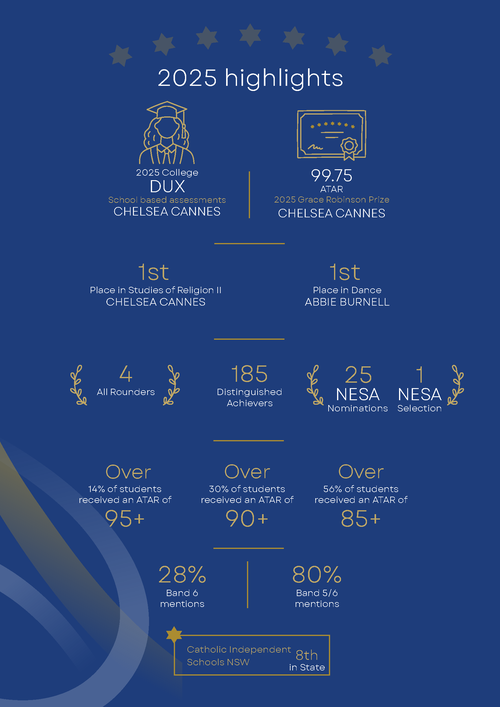
Our Academic Assembly, held on Wednesday, was a proud and affirming celebration of the achievements of the Class of 2025. It has been over 3 months since we last saw these young women at the College, and already they have transformed as they have let go of the demands of the HSC and embraced new freedoms that come with travel and employment.
Some of our Alumni were unable to be with us as they undertake volunteer programs in Nepal, commence their studies at ADFA whilst others negotiated brief release from courses and study programs that have already commenced. Of the ex-students who attended, some are in the throes of packing as they look forward to travelling interstate for University opportunities or overseas to enjoy a combination of work and travel.
The assembly brought our community together to recognise the sustained effort, intellectual curiosity and quiet perseverance that underpin genuine scholarly success. It was a moment to pause and acknowledge the discipline required to meet deadlines, the courage to engage with challenging ideas, and the resilience developed through moments of uncertainty and growth.
We also celebrated the students who achieved academic excellence in one or more disciplines. The successes of the Class of 2025 reflect diverse strengths and pathways, reminding us that academic excellence is not singular but richly varied.
We also had the pleasure of hearing from Chelsea Cannes, our College Dux, Grace Robinson prize recipient for the highest ATAR and MAEL Award recipient for the highest ATAR across all Mary Aikenhead schools. Chelsea demonstrated true mastery of language and speech writing delivering a powerful and motivational address to Years 11 and 12, without the need or aid of notes or script. The resounding applause from the audience acknowledged the strength and authenticity of her words, an abridged extract of which is below:
Since graduating, I have continued to develop my appreciation for my subjects by simply engaging with the news and media. I have observed the alarming parallels between the Modern History syllabus and current political developments on the world stage. I have recognised the pertinence of Studies of Religion in a society increasingly fractured by religious intolerance. HSC courses empower us to see the world in an informed light, cultivating empathy and intellectual curiosity along the way, and embracing the power of education early on can be a great way to develop intrinsic motivation to study.
It was through this broader perspective that I learned to approach the HSC with greater compassion for myself and my peers, and I would like to leave you with a few tips to help you thrive both individually and collectively. Perhaps most importantly, disregard the instinct to keep to your own devices and study in solitude. The HSC challenges students to work together as a cohort, and embracing collaboration over individualism will be vital to your collective success. …
Another self-imposed battle you may find yourself in is to avoid taking breaks and study for as long as physically possible. In the initial stages of my HSC, I believed that I was immune to burning out simply because I had developed a habit of studying and resisted my family’s calls for me to go outside. Over time, however, my willingness to study began to falter, and I found that sitting at my desk for extended periods of time merely exacerbated my lack of motivation. Fortunately, I had developed an alternative way of studying whilst staying active, which involved me lecturing my mum on topics I was studying as we embarked on long walks, allowing me to articulate and consolidate my content before exams. …
Equally important is recognising that asking for help is not a sign of weakness. Throughout Year 11 and Year 12, I intensely feared feedback. I saw it as an attack on my character rather than an opportunity for growth. I soon came to realise, however, that embracing feedback was the very means through which I could overcome my battle with self-doubt.
We thank Chelsea for her fine words and celebrate the Class of 2025 for the intellectual energy and integrity they have brought to our academic culture.
Alison Boyd-Boland
Directory of Teaching and Learning
ISSUE 1 | 30 Jan 2026
I would like to take this opportunity to welcome students and their families back to the College as we commence the 2026 academic year. While teachers were back on site last week, the College came to life when students returned. There has been a renewed sense of energy across the campus as the corridors once again fill with the rhythm of school life: the movement between classes, the steady hum of conversation flowing from learning spaces and joyful reconnections in the courtyards. Encouragingly, many students have already spoken about engaging first lessons, the care teachers have taken to establish purposeful learning environments, and the beginnings of strong, and purposeful learning relationships.
In my role as English teacher, I came across a poet last year who was new to me. Mary Oliver is an American poet, Pulitzer prize winner, and master at sharing messages about the importance of finding joy and the wonder of the natural world. In one of her poems, titled ‘Sometimes’ she offers advice that offers us a challenge for the year ahead. She writes:
Instructions for living a life:
Pay attention.
Be astonished.
Tell about it.
At its heart, education begins with attention: noticing ideas, patterns, questions, and possibilities. From attention comes astonishment, the moment when something challenges us, surprises us, or opens a new way of seeing the world. Learning asks us to respond: to articulate our thinking, to test ideas, to share understanding with others.
This is a fitting lens through which to begin the school year. Learning is not a passive process of receiving information, but an active partnership between students and teachers. When classrooms are spaces of curiosity and dialogue, teachers stand alongside students, guiding, questioning, and modelling a love of learning. It is through these thoughtfully designed moments that students are encouraged to think deeply, take intellectual risks, and grow in confidence and independence.
As the year unfolds, I hope every student finds opportunities to pay attention, to be challenged and inspired, and to discover something that sparks genuine curiosity and passion. Best wishes to all our learners and their families for a rewarding and fulfilling 2026 academic year.
Alison Boyd-Boland
Directory of Teaching and Learning